Books
Long books you can print.
These are the long manuals. Short lessons are under Start a lesson. Academy books sit with their subject. Operator books are for parents who already run Hermes. Empty subjects stay off this page until a title lands.
Editorial principle. Show disagreements, not just sequence. The reader is the jury.
Academy
Teaching-manuals
Age-banded Hour books and longer arguments tied to a sitting. Not a hosted kit.
The spine
Autonomous AI
Subject hub →What an agent is, what it is not, and how to stay the operator.
The filter
Critical Thinking
Subject hub →Claims, counterclaims, and what would change your mind.
- Published
Critical Thinking for Life
The Practice Hour
Critical thinking is reasonable reflective thinking focused on deciding what to believe or do. Maxims are not enough. You need something to think about, a practice hour you can run this week, and a test that is not the thing. Machines that finish the sentence do not finish the judgment.
1900–2026~3.5 hours · 168 pages14 chapters - Published
Critical Thinking Skills for Little Thinkers
The Thinking Hour
The thinking hour at the table is the whole program: something to look at, a question worth waiting for, a reason to hear, one other thing to check. A parent who is not a philosopher can run that hour for five-to-ten — picture books, snacks, weather, a friend’s sentence — if a wish is not allowed to pass as a look out the window.
2026~4 hours · 191 pages14 chapters - Published
Critical Thinking for Young Minds
The Thinking Hour
The thinking hour at the table is the whole program: something to look at, a question worth waiting for, a reason to hear, one other thing to check. A parent who is not a philosopher can run that hour for eleven-to-fifteen — a recap versus a box score, two forecasts, a spec sheet, a rainfall graph, who should be captain — if an own-side because is not allowed to pass as a look at the second source.
2026~4 hours · 202 pages14 chapters - Published
Critical Thinking for Emerging Adults
The Thinking Hour
The thinking hour at the table is the whole program: something they already know, a question worth waiting for, a look at one other thing, and a short written reason a stranger could follow. A parent who is not a philosopher can run that hour for fifteen-to-eighteen — a recap versus a box score, two forecasts, a spec sheet, a rainfall graph, a claim in a short essay — if an own-side because is not allowed to pass as a finished argument.
2026~4 hours · 203 pages14 chapters - Published
Critical Thinking for Adults
The Work Hour
The thinking on this job is the whole program: something you already know, a question worth waiting for, a look at one other thing, and a short written reason a colleague who missed the meeting could follow. A working adult who is not a philosopher can run that hour at a desk, on a shift, in a bay — if an own-side because is not allowed to pass as a finished argument, and a model’s paragraph is not allowed to pass as a reason.
2026~4 hours · 180 pages14 chapters
Classics
Wisdom & Philosophy
Subject hub →The Stoics and the examined life, rewritten for the age in the chair.
- Published
The Stoics
A WisdomForge Reader
The Stoics did not agree with each other. This book is not a daily digest and not a conversion manual. It reconstructs the conversations among Zeno, Cleanthes, Chrysippus, Aristo, Musonius, Seneca, Epictetus, and Marcus — four questions, disagreements left open, ugly clauses kept. Panaetius and Posidonius are named as a transmission hole, not seated as full voices. The reader is the jury.
c. 334 BCE – 180 CE (plus afterlives)~4 hours · 160 pages6 chapters - Published
The Church Fathers
A WisdomForge Reader
The Church Fathers did not agree with each other. They argued — about creation, salvation, authority, Scripture, and what it means to live well — and the arguments are still alive. This book is not a summary of what they believed. It is a reconstruction of the conversations they had, the questions they could not settle, and the answers that shaped Western civilization for 1,600 years.
130–1416 CE~4 hours · 155 pages7 chapters
Number
Mathematics
Subject hub →Estimate, show the method, then ask a tool to check the path — never the soul of the work.
- Published
Mathematics for Homeschooling
A Path, Not a Percentile
A parent who is not a math specialist can take a child from first-grade number sense through high-school calculus if three things hold: the parent can hear a wrong answer; the child does the struggle before the tool; and any agent is a parent-hosted supplement, not a substitute and not a school-safe product by default. Documents do the work. The popular story does not survive.
2000–2026~5 hours · 226 pages15 chapters - Published
Math for Little Thinkers
The Math Hour
The math hour at the table is the whole program: counters or a line, a question worth waiting for, a number sentence they write. A parent who is not a mathematician can run that hour for five-to-ten — counting, the equal sign, equal groups, fractions on a line — if 1/2 + 1/3 = 2/5 is heard as a size mistake, not a cute slip.
2026~4.5 hours · 207 pages14 chapters - Published
Math for Young Minds
The Math Hour
The math hour at the table is the whole program: a ratio table or a number line that runs both ways, a question worth waiting for, an equation they write and check. A parent who is not a mathematician can run that hour for eleven-to-fourteen — fractions as numbers, ratio, signed numbers, expressions, equations — if cross-multiply with no table is heard as a missing-meaning move, not a cute slip.
2026~4 hours · 188 pages14 chapters - Published
Math for Emerging Adults
The Math Hour
The math hour at the table is the whole program: a solved equation with structure, a short proof with reasons, a function family from a table, a unit-circle location, a rate that becomes instantaneous, a sample that is not yet a population claim. A parent who is not a mathematician can run that hour for fifteen-to-eighteen — if letter-moving with no structure is heard as a missing-meaning move, not a cute slip, and a birthday is not allowed to pass as Calculus readiness.
2026~4 hours · 170 pages12 chapters - Published
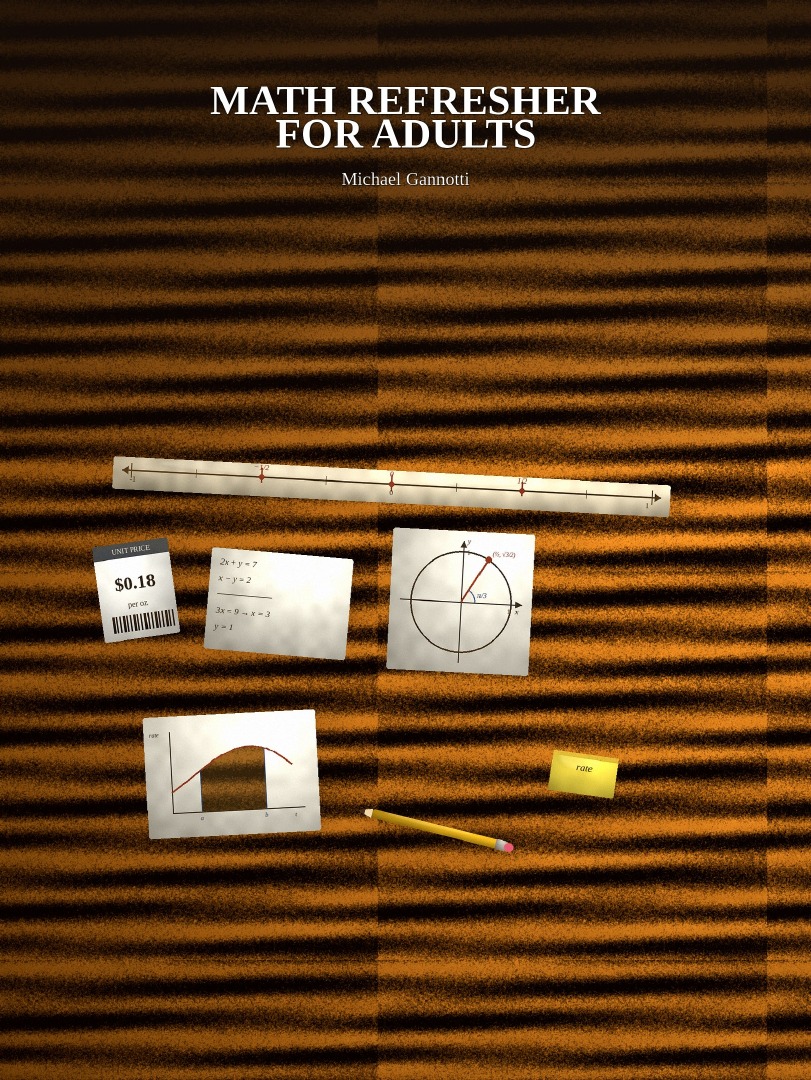
Math Refresher for Adults
The Refresh Hour
Usable mathematics is ordinary adult work: a number on a line, a unit price on a shelf, a percent on a dashboard, a short reason for a measurement. A working adult who is not a mathematician can run that hour on a train, at a desk, on a shift — if “of means multiply” is heard as a keyword grab, not a schema, and a calculator output is not allowed to pass as sense.
2026~3.5 hours · 167 pages13 chapters
Nature
Science
Subject hub →Hypothesis before search. The universe is not a chatbot.
- Published
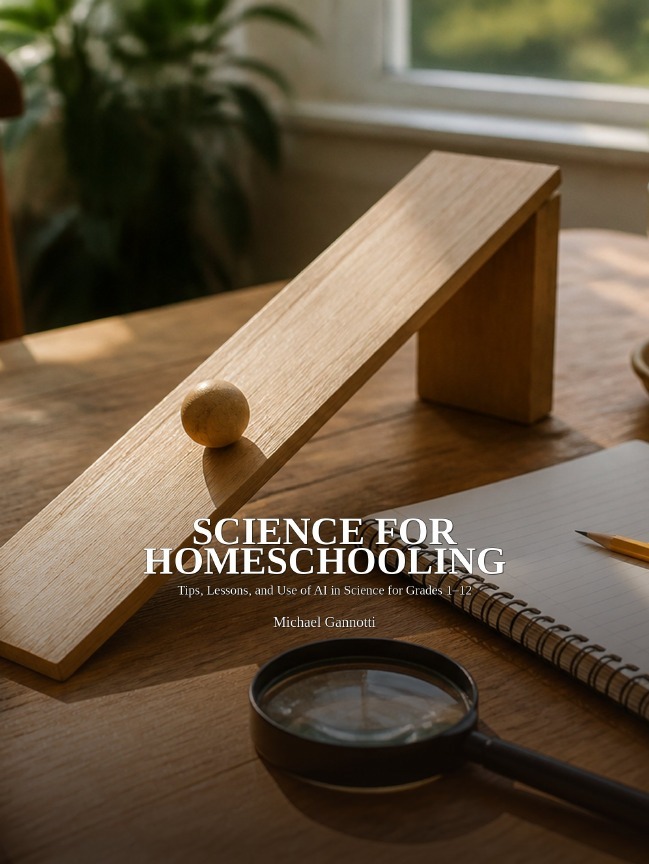
Science for Homeschooling
The Science Hour
The science hour at the table is the whole program: look, try, record, wait for the question. A parent who is not a scientist can take a child from first-grade looking-and-trying through biology, chemistry, physics, and earth and space if the child holds the notebook and the parent can hear a wrong explanation.
2026~4.5 hours · 215 pages14 chapters - Published
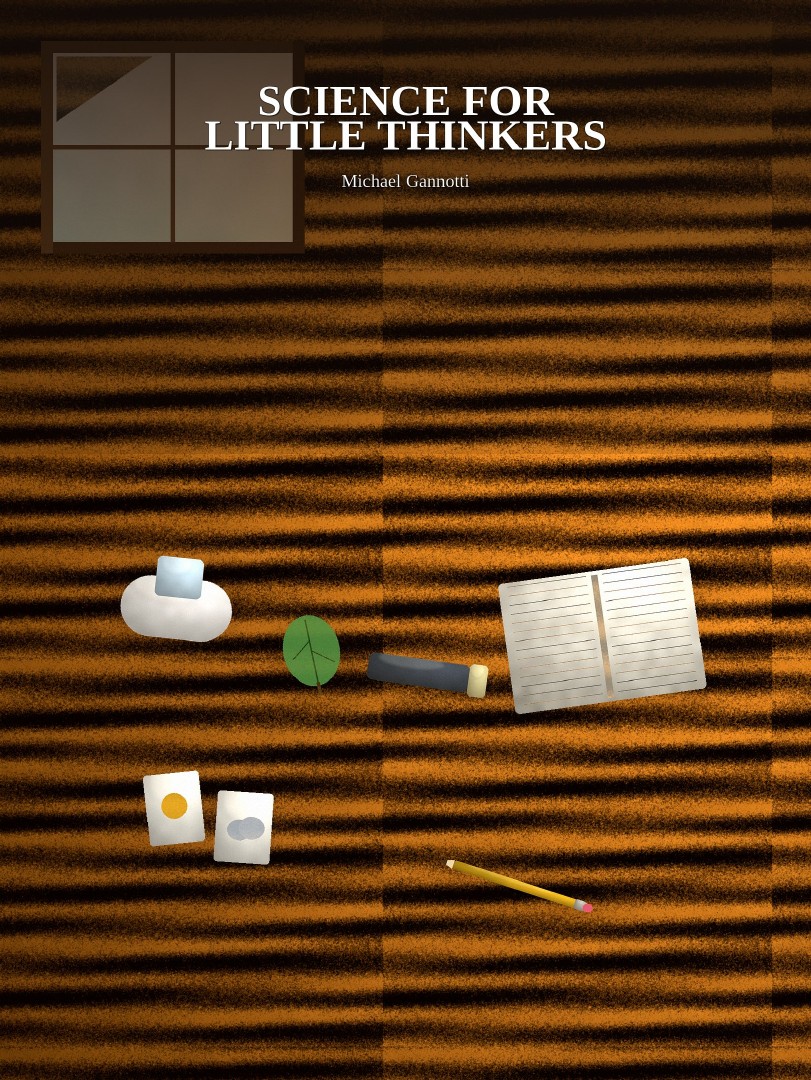
Science for Little Thinkers
The Science Hour
The science hour at the table is the whole program: lookable before explanation, one good question you wait for, a drawing that is the data. A parent who is not a scientist can run that hour for five-to-ten — ice, leaf, ramp, weather card — if a generated ice-melt paragraph is not allowed to pass as looking.
2026~4 hours · 201 pages14 chapters - Published
Science for Young Minds
The Science Hour
You don't need to be a scientist to teach science at home to an 11- to 14-year-old. This book gives you a simple weekly Science Hour built around fair tests on the kitchen table, a notebook your student fills with what they actually measured, and good questions you're willing to wait on. Step by step, your student learns to turn a table into a graph into a sentence, and to back up a claim with evidence.
2026~3.5 hours · 182 pages14 chapters - Published
Science for Emerging Adults
The Science Hour
This book helps you guide a 15- to 18-year-old through real high-school science at home, even if lab work isn't your background. A weekly Science Hour builds two lasting habits: looking at the world as connected systems, and making lab claims backed by evidence in a notebook a stranger could follow. Biology, chemistry, and physics become the vehicles for those habits, with clear guidance on safety, records, and lab credit.
2026~4 hours · 185 pages14 chapters - Published
Science Refresh for Adults
The Science Refresh Hour
Usable science literacy is ordinary adult work: a feed card that says study shows, a workplace slide, a pharmacy label with a rate, a weather page. A working adult who is not a scientist can run that hour on a train or after work — if a caption is not allowed to pass as the study, and a model précis is not allowed to pass as an observation.
2026~3.5 hours · 175 pages13 chapters
Letters
English
Subject hub →You write the draft. The guide is an editor who asks questions, not an author with your name on it.
- Published

English for Homeschooling
The English Hour
A path, not a percentile. The child writes the draft. The parent hears a wrong answer in the code, the sentence, and the claim. A model can drill; it cannot take the exam of being understood. Birthday is not placement.
2026~4.5 hours · 194 pages14 chapters - Published
English for Little Thinkers
The English Hour
The English hour at the table is the whole program: letter tiles or a sound box, a question worth waiting for, a page they look through, a sentence they write. A parent who is not a reading specialist can run that hour for five-to-ten — sounds linked to letters, blending, fluency after accuracy — if a picture guess is not allowed to pass as word reading.
2026~4 hours · 193 pages14 chapters - Published
English for Young Minds
The English Hour
The English hour at the table is the whole program: a word stripped into parts, a rich page with one scaffold, a claim with evidence, a draft they revise for one named target. A parent who is not a reading specialist can run that hour for eleven-to-fourteen — morphology, volume with scaffolds, academic vocabulary — if an AR quiz is not allowed to pass as comprehension, and a blank page is not allowed to pass as “just write.”
2026~4 hours · 191 pages14 chapters - Published
English for Emerging Adults
The English Hour
The English hour at the table is the whole program: a word stripped into parts, a dense page with one scaffold, a claim with evidence and a warrant, a seminar turn, a draft they revise for one named target. A parent who is not a reading specialist can run that hour for fifteen-to-eighteen — if an AR quiz is not allowed to pass as comprehension, AP is not allowed to pass as the only honest path, and a chatbot is not allowed to pass as the essay partner.
2026~4.5 hours · 220 pages14 chapters - Published
English for Adults
The Refresh Hour
Usable literacy is ordinary adult work: a word that yields to its parts, a paragraph whose job you can name, a claim with evidence and a warrant, an email that leads with the ask. A working adult who is not a novelist can run that hour on a train, at a desk, on a shift — if highlight-and-hope is not allowed to pass as comprehension, and a chatbot rewrite is not allowed to pass as your only draft.
2026~4 hours · 180 pages13 chapters - Published
English for the Dyslexic
The English Hour (Structured Literacy)
A teaching manual for English with a child who finds word reading and spelling unexpectedly hard. It does not diagnose. It teaches a parent of grades 1–12 how to run Structured Literacy intensity: clear teaching, a planned sequence, daily review, and tomorrow’s lesson shaped by today’s errors — if colored overlays, a leveled ladder, and “just read more” are not allowed to pass as the intervention.
2026~5.5 hours · 266 pages14 chapters - Published
English for Young Thinkers with Dyslexia
The English Hour (Structured Literacy for Ages 5–10)
A teaching manual for English with a five- to ten-year-old who finds word reading and spelling unexpectedly hard. It does not diagnose. It teaches a parent how to run Structured Literacy intensity at that table — if “wait, they’ll catch up,” colored overlays, and a leveled ladder are not allowed to pass as the intervention.
2026~5.5 hours · 259 pages14 chapters - Published
English for Young Minds with Dyslexia
The English Hour (Structured Literacy for Ages 11–14)
A teaching manual for English with an eleven- to fourteen-year-old who finds word reading and spelling unexpectedly hard. It does not diagnose. It teaches a parent how to run Structured Literacy intensity at that table — if “phonics is over at 11,” AR points, and a baby-decodable book are not allowed to pass as the intervention.
2026~5 hours · 226 pages14 chapters - Published
English for Emerging Adults with Dyslexia
The English Hour (Structured Literacy for Ages 15–18)
A teaching manual for English with a fifteen- to eighteen-year-old who finds word reading and spelling unexpectedly hard. It does not diagnose. It teaches a parent how to run Structured Literacy intensity at that table — if “phonics is over in high school,” wait-until-college, and “just read more” are not allowed to pass as the intervention.
2026~5 hours · 229 pages14 chapters
Then
History
Subject hub →Primary sources first. Summaries — human or machine — are claims.
- Published
Publius
How a New York Newspaper War Became America's Civic Scripture
The Federalist is not the Constitution. It is eighty-five newspaper essays written in New York, 1787–88, under a Roman mask, to win a ratification vote. This book is the campaign, the three men behind Publius, the designed opponent in Brutus, the arguments that later classrooms flattened, and the Anti-Federalist amendments that still sit on the machine they failed to stop.
1787–1788~4 hours · 187 pages15 chapters - Published

History for Homeschooling
The History Hour
A path through history, not a date slog. Pictures before dates. Who made this, before the body. The child looks; the parent hears presentism. A generated diary is not a source. Birthday is not placement.
2026~5 hours · 205 pages14 chapters - Published
History for Little Thinkers
The History Hour
The history hour at the table is the whole program: a piece from then before the story, who made this before the caption, one good question you wait for. A parent who is not a historian can run that hour for five-to-ten — pictures, objects, oral history, maps as place — if a generated diary is not allowed to pass as a source.
2026~4 hours · 192 pages14 chapters - Published
History for Young Minds
The History Hour
The history hour at the table is the whole program: a named source before the tidy summary, who-when-for-whom before the body, two accounts when the week needs them. A parent who is not a historian can run that hour for eleven-to-fourteen — if a textbook-as-the-facts answer and a model summary are not allowed to pass as the source.
2026~4 hours · 183 pages14 chapters - Published
History for Emerging Adults
The History Hour
The history hour at the table is the whole program: a named founding document before the tidy story, who-when-for-whom-against-what-problem before the body, then-words before now-lectures. A parent who is not a historian can run that hour for fifteen-to-eighteen — if an AP binder, an encyclopedia of years, or a fluent review-book paragraph is not allowed to pass as looking.
2026~4 hours · 190 pages14 chapters - Published
History Refresh for Adults
The History Refresh Hour
Usable civic literacy is ordinary adult work: a feed card, a ballot pamphlet, a plaque, a short civic excerpt with a credit line. A working adult who is not a historian can run that hour on a train or after the kids are in bed — if a caption is not allowed to pass as the event, and a model précis is not allowed to pass as a primary.
2026~3.5 hours · 170 pages13 chapters
Make
Hands before generate. Taste is a muscle. Tools are not a substitute for seeing.
- Published
Art for Homeschooling
The Studio Hour
A path through making, not a talent myth. The studio hour at the table is the whole program: look, demo, the child holds the tool, one unaided piece. Image generators do not get the child's project. Birthday is not placement.
2026~5 hours · 210 pages14 chapters - Published
Art for Little Thinkers
The Art Hour
The art hour at the table is the whole program: object before the name, child's mark on the child's page before polish. A parent who is not a studio artist can run that hour for five-to-ten — mug, leaf, fat crayon, two tempera puddles — if a generated image is not allowed to pass as the child's work.
2026~4 hours · 196 pages14 chapters - Published
Art for Young Minds
The Art Hour
You do not need to be an artist to teach an eleven- to fourteen-year-old to draw what they see. An object on the table, one question, and the patience to wait. The art hour is that hour.
2026~4.5 hours · 161 pages14 chapters - Published
Art for Emerging Adults
The Art Hour
You do not need to be an artist to mentor a fifteen- to eighteen-year-old through a real year of art. Protect the time, set up a safe corner, ask good questions, find outside eyes, and keep honest records. The student does the looking and the making, and more and more, the leading.
2026~4.5 hours · 161 pages14 chapters - Published
Art Refresh for Adults
The Art Refresh Hour
A warm self-study for the adult coming back. You are the learner. There is no teacher's edition and no student section, because you are both. Rust on the first page is ordinary.
2026~4.5 hours · 143 pages14 chapters
Systems
Computer Science
Subject hub →Specify the agent: soul, tools, refuse-list. Code is permission made explicit.
- Published
Computer Science for All Ages
The Computing Hour
The computing hour at the table is the whole program: a device to look at, a file to save, a try that might not run. A parent who is not a computer scientist can take a child from first-grade looking-at-devices through hardware, operating systems, networking, first programs, and AI as a topic — if the child holds the keyboard and the parent can hear “the computer is thinking” as a mix-up, not a compliment.
2026~4 hours · 202 pages14 chapters - Published
Computing for Little Thinkers
The Computing Hour
You do not need to be a programmer to teach a five- to ten-year-old real beginning computing. Ask what they think will happen before anyone presses go, and leave the child's program in the child's hands. Unplugged first.
2026~4.5 hours · 159 pages14 chapters - Published
Computing for Young Minds
The Computing Hour
This book helps you teach real computing at home to an 11- to 14-year-old, even if you've never written code. In a weekly Computing Hour, your student plans before typing, writes first programs in Python, builds web pages, and learns to treat errors as clues to solve. Along the way they learn how computers and networks work, how to stay safe and kind online, and how to use AI honestly.
2026~5 hours · 175 pages14 chapters - Published
Computing for Emerging Adults
The Computing Hour
This book helps you guide a 15- to 18-year-old through high-school computer science at home, whether or not you code yourself. A weekly Computing Hour builds working habits: write a plan before building, test before trusting, debug instead of rewriting, and be able to explain every line. Your teen works through Python, objects and classes, data and databases, the web, the command line, Git, security, and AI, with clear guidance on records, AP, and dual enrollment.
2026~4.5 hours · 168 pages14 chapters - Published
Computing Refresh for Adults
The Computing Refresh Hour
This book is for adults who want to come back to computing, whether you coded years ago or always meant to start. In short, steady sessions you'll learn to plan before you build, use Python as a working tool, test and debug calmly, work with data and the web, and keep your household's systems safe. It also shows you how to use AI without giving away your own learning, and how to coach your kids as you grow.
2026~4 hours · 148 pages14 chapters
Voice
World Languages
Subject hub →Say it yourself. A model can drill; it cannot take the exam of being understood.
- Published
Teaching World Languages for Homeschooling
The Language Hour
The language hour at the table is the whole program: hear, say, one real use. A parent who is not a speaker can take a child through Spanish, French, Italian, German, Chinese, Japanese, or Korean if the child does the talking and the parent can hear a wrong phrase.
2026~4.5 hours · 208 pages14 chapters - Published
Languages for Little Thinkers
The Language Hour
You don't need to be fluent to help a 5- to 10-year-old start a new language. This book gives you a short, playful Language Hour built on listening, songs, games, stories, and real little conversations, and it works for any language, including American Sign Language. Whether you're learning alongside your child or keeping a family language strong, a little every day goes a long way.
2026~4 hours · 143 pages14 chapters - Published
Languages for Young Minds
The Language Hour
You don't need to speak the language to help an 11- to 14-year-old learn it well. This book gives your family a daily Language Hour in five steps: take in language your student mostly understands, make words stay, then use them with real people and check what they can do. Along the way your student takes the lead, with clear, calm rules for tutors, online safety, and AI tools.
2026~4.5 hours · 153 pages14 chapters - Published
Languages for Emerging Adults
The Language Hour
A warm, practical guide for a parent-mentor and a 15- to 18-year-old learning any world language, including ASL. The teen runs a daily Language Hour (Set the Target, Take It In, Work With It, Use It for Real, Check and Log) and builds a year that counts: honest timelines, listening at real speed, words and patterns that stay, real reading and new scripts, speaking and writing with real people, safe ways out into the world, tools and AI used under their terms, and credit, transcripts and proof a stranger can trust.
2026~4 hours · 135 pages14 chapters
Operator
Hermes books
For a parent who already uses Hermes. Not the front door. Not a sitting.
- Published
Hermes AI for Beginners
Your Complete Guide to Running an AI Agent That Actually Works
A practical guide to installing, configuring, and running Hermes Agent — the open-source agent that lives on your machine. Skills Hub, memory, browser, terminal, cron, and the difference between Hermes the agent and Hermes the models. Edition note: August 2026. Official install is install.sh, install.ps1, or the Desktop app — not pip into system Python.
2026~8 hours · 364 pages15 chapters - Published
Hermes Mastery
From First Install to a Working AI Team
Hermes AI for Beginners is the on-ramp. This book is the rest of the map: profiles, Bot Mode, group rooms, kanban, cron, and the gateway that is still running after you sleep. Official install is install.sh, install.ps1, or the Desktop app. Skills Hub, not ClawHub. Bots are profiles. Freeze-dated 30 August 2026 against live Nous docs.
2026~4 hours · 177 pages20 chapters - Published
AI Agents Projects for Beginners
25 Projects to Build, Run, and Deploy Your Own Intelligent Agents
Twenty-five projects from hello-agent to a capstone deploy. Research, files, email, browser, multi-agent teams, and an observatory. Companion references for OpenClaw, Hermes, and Ollama. Build first. The model is a component, not the project.
2026~10 hours · 512 pages25 chapters - Published
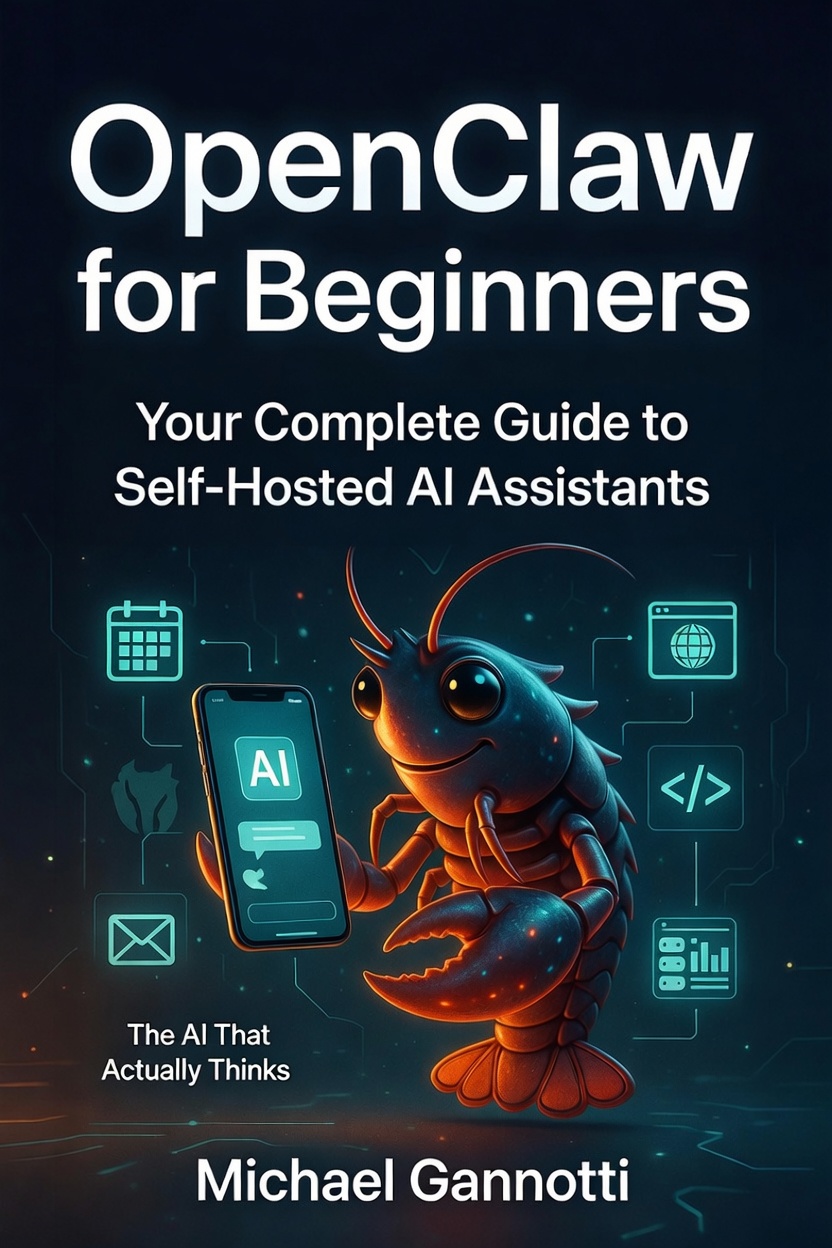
OpenClaw for Beginners
Your Complete Guide to Self-Hosted AI Assistants
A practical guide to installing and operating OpenClaw — the self-hosted AI assistant. Channels, model providers, skills, ClawHub, security, and compliance. Edition note: August 2026. Official install is install.sh or Windows install.ps1.
2026~10 hours · 480 pages15 chapters